
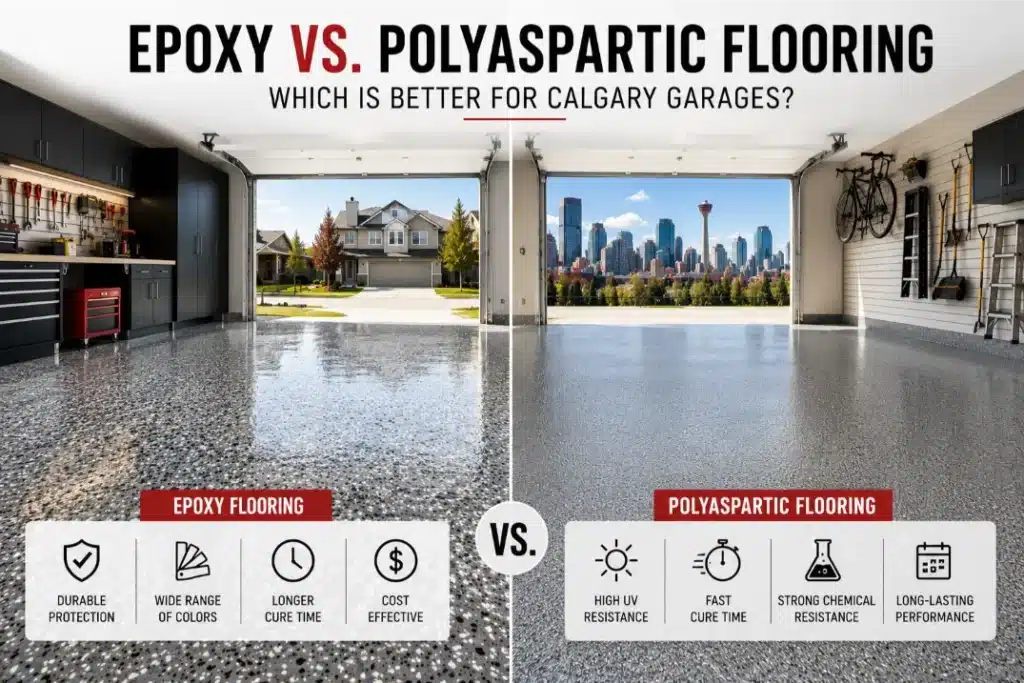
If you’re planning to upgrade your garage floor, you’ve probably come across two popular options: epoxy and polyaspartic flooring. Both can transform an ordinary concrete garage floor into a cleaner, more attractive, and more durable surface.
But which one is better for a Calgary garage?
The answer isn’t as simple as choosing whichever coating is more popular. Calgary garages have to deal with road salt, moisture, snow, dirt, temperature changes, vehicle traffic, and everyday wear. Your choice should therefore depend on how you use your garage, the condition of the concrete, your budget, and the type of finish you want.
If you’re researching epoxy flooring Calgary options, this guide breaks down epoxy and polyaspartic flooring in simple terms so you can make a more informed decision.
Epoxy vs. Polyaspartic: What’s the Difference?
Both epoxy and polyaspartic are coating systems that can be applied over properly prepared concrete, but they have different characteristics.
Epoxy has been a popular choice for garages, workshops, commercial spaces, and industrial floors for years. It creates a strong, seamless surface and can be customized with different colours, decorative flakes, and finishes.
Polyaspartic is a newer type of coating that is often selected for its fast curing characteristics, UV resistance, and ability to perform well in demanding environments.
Neither option is automatically “better” for every garage. The right choice depends on the project.
1. Durability: Which Flooring Can Handle More Wear?
For most homeowners, durability is one of the first things they consider.
A garage floor needs to deal with vehicle tires, foot traffic, dropped tools, storage equipment, dirt, and occasional impacts. In some homes, the garage may also double as a workshop or hobby area.
A properly installed epoxy system can provide a hard and durable surface that protects the concrete underneath.
Polyaspartic coatings can also provide excellent durability and are often selected for demanding garage and commercial applications.
The important word here is properly installed.
The quality of the concrete preparation, coating system, application process, and final protective layer can have a major impact on how the finished floor performs.
So rather than simply asking whether epoxy or polyaspartic is stronger, ask:
Which system is appropriate for how I actually use my garage?
2. Calgary Weather Matters
Calgary’s climate is another important consideration.
Throughout the year, garages can be exposed to moisture, road salt, sand, dirt, and temperature fluctuations. In winter, snow and ice can be carried into the garage by vehicles and footwear.
This makes moisture management and proper installation especially important.
Both epoxy and polyaspartic systems can provide a sealed surface over properly prepared concrete. However, the existing concrete should be assessed before installation.
Cracks, surface damage, moisture issues, and contamination should be addressed as part of the preparation process.
A high-quality coating cannot fix an underlying concrete problem that hasn’t been properly dealt with.
3. Installation and Curing Time
This is one area where polyaspartic flooring can have an advantage.
Polyaspartic coatings are known for relatively fast curing times, which can make them attractive for homeowners who don’t want their garage out of use for an extended period.
Epoxy systems can require more time to cure, depending on the product, temperature, humidity, number of coats, and installation conditions.
For a homeowner with another place to park a vehicle, this may not be a major concern.
But if your garage is essential to your daily routine, installation downtime could influence your decision.
Always ask your contractor how long the complete process will take—not just how long it takes to apply the coating.
4. UV Resistance and Colour Stability
Another difference worth considering is exposure to sunlight.
Polyaspartic coatings generally offer strong UV resistance, making them a popular choice where colour stability and exposure to sunlight are concerns.
Traditional epoxy coatings can be more susceptible to UV-related colour changes when exposed to direct sunlight, depending on the specific formulation and topcoat used.
For a typical enclosed garage, this may not be a major issue.
However, if your garage receives substantial sunlight through windows or doors, discussing UV exposure with your flooring contractor is worthwhile.
The right topcoat and complete flooring system can also influence the final performance.
5. Appearance and Design Options
Your garage floor doesn’t have to be boring.
Both epoxy and polyaspartic flooring can be customized to create a professional and attractive finish.
One popular option is flake flooring.
Decorative flakes are broadcast into the coating to create a multi-colour appearance. They can add visual interest while helping hide small amounts of everyday dirt and debris.
Other options can include:
- Solid colours
- Decorative flake systems
- Metallic finishes
- Gloss finishes
- Textured surfaces
If appearance is important to you, ask to see actual samples or completed projects before making a decision.
A flooring professional can also help you choose a finish that complements your garage cabinets, walls, lighting, and overall design.
6. Maintenance and Cleaning
Nobody wants a garage floor that takes hours to clean.
This is another area where both epoxy and polyaspartic coatings can be practical.
A properly installed seamless coating can make routine cleaning easier than maintaining worn or porous concrete.
Mud, dust, road salt, and everyday spills can generally be removed through routine cleaning.
For Calgary homeowners, this can be especially useful during winter when vehicles may bring moisture and salt into the garage.
However, maintenance still matters. Using appropriate cleaning products and avoiding harsh chemicals that aren’t compatible with the coating can help maintain the floor’s appearance and performance.
7. Cost: Is Epoxy or Polyaspartic More Affordable?
Price is naturally an important factor.
The final cost of garage flooring depends on several variables, including:
- Garage size
- Condition of the existing concrete
- Required repairs
- Surface preparation
- Coating system
- Number of coats
- Decorative finish
- Topcoat
- Labour
- Project complexity
In many cases, epoxy can be a cost-effective choice, while polyaspartic systems may come at a higher price depending on the installation.
But comparing only the initial price can be misleading.
Instead, consider the overall value.
A properly installed flooring system that performs well for your garage may be a better investment than choosing the cheapest available coating and dealing with premature problems later.
Epoxy vs. Polyaspartic: Quick Comparison
| Feature | Epoxy | Polyaspartic |
|---|---|---|
| Durability | Excellent | Excellent |
| Design options | Excellent | Excellent |
| UV resistance | Depends on system/topcoat | Generally excellent |
| Cure time | Generally slower | Generally faster |
| Garage use | Excellent | Excellent |
| Maintenance | Easy | Easy |
| Customization | Wide range | Wide range |
| Cost | Often more budget-friendly | Can be higher |
| Best for | Durable, customizable garage floors | Fast-curing, high-performance applications |
This comparison is a general guide. The actual performance depends heavily on the specific products, installation process, concrete condition, and environment.
Which Is Better for a Calgary Garage?
So, should you choose epoxy or polyaspartic?
Choose Epoxy If:
You may prefer epoxy if you want:
- A durable garage floor
- Extensive colour and design options
- Decorative flake flooring
- A cost-conscious solution
- A proven coating system
- A clean and professional finish
For many homeowners looking for epoxy flooring Calgary services, epoxy remains an attractive option because it combines durability, appearance, and practicality.
Consider Polyaspartic If:
Polyaspartic may be worth considering if you prioritize:
- Faster curing
- Strong UV resistance
- High-performance applications
- Quick return to garage use
- A durable protective system
For homeowners who want their garage completed quickly or have specific performance requirements, polyaspartic can be an excellent alternative.
The Most Important Factor: Professional Installation
It’s easy to focus on the coating itself and overlook the preparation underneath.
But concrete preparation is one of the most important parts of the project.
Before applying a coating, the surface may need to be mechanically prepared, cleaned, and repaired. Existing cracks, contaminants, moisture conditions, and damaged areas should be assessed.
If the coating is installed over poorly prepared concrete, even a high-quality product may not perform as expected.
That’s why it’s important to choose an experienced garage flooring contractor in Calgary rather than simply purchasing a DIY kit based on price.
What Should Calgary Homeowners Ask a Flooring Contractor?
Before starting your project, ask:
- Which coating system do you recommend for my garage?
- Why is it suitable for my specific use?
- How will you prepare the concrete?
- Are there existing cracks or moisture problems?
- How long will installation take?
- When can I park my vehicle inside?
- What type of topcoat will be used?
- How should the finished floor be maintained?
- What warranty is provided?
A professional contractor should be able to explain the process clearly and help you understand why a particular system is being recommended.
Final Verdict
There isn’t one universal winner in the epoxy vs. polyaspartic flooring debate.
For many Calgary homeowners, epoxy offers an excellent balance of durability, customization, appearance, and value. Polyaspartic can be a strong choice when faster curing, UV resistance, or specific performance requirements are priorities.
The best flooring system is ultimately the one that matches your garage, your budget, your expectations, and the condition of your existing concrete.
If you’re considering epoxy flooring Calgary homeowners can rely on, B Jacob Construction can help you explore the available flooring options and determine which system makes sense for your project.
From epoxy garage flooring and decorative flake systems to polyaspartic and other high-performance flooring solutions, the right installation can turn a basic concrete garage into a cleaner, more durable, and more attractive part of your home.
Ready to upgrade your garage floor? Contact B Jacob Construction to discuss your Calgary garage flooring project and find the right coating for your needs.